Date: July 16, 2026
Table of Contents
Introduction
What is the Protection of Women from Domestic Violence Act, 2005?
Applicable Laws and Relevant Sections
Rights Available to Women Under the Act
Procedure to Seek Relief
Documents That May Be Required
Penalties for Breach of Protection Orders
Important Judicial Decisions
Practical Examples
Common Mistakes to Avoid
Frequently Asked Questions
Conclusion
Introduction
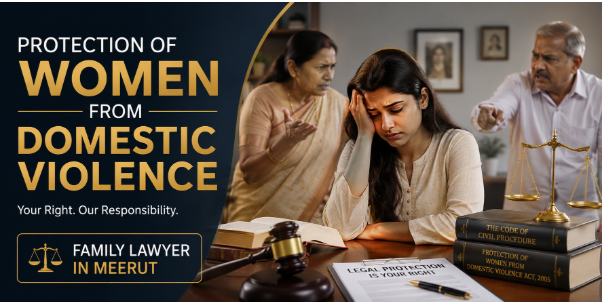
Every woman has the right to live with dignity, safety, and freedom from abuse. The Protection of Women from Domestic Violence Act, 2005 (PWDVA) was enacted to provide immediate and effective civil remedies to women facing domestic violence within the family or household.
If you or someone you know is experiencing domestic violence, understanding your legal rights is the first step toward protection. A qualified Family Lawyer in Meerut can help you understand the legal process, seek appropriate relief, and protect your rights under Indian law.
What is the Protection of Women from Domestic Violence Act, 2005?
The Protection of Women from Domestic Violence Act, 2005 is a special legislation enacted to protect women from various forms of domestic violence. Unlike laws that only punish offenders, this Act primarily provides civil reliefs such as protection, residence, maintenance, custody, and compensation, while breach of certain court orders can attract criminal consequences.
The Act covers women who are or have been in a domestic relationship with the respondent, including wives, mothers, daughters, sisters, widows, and women in relationships in the nature of marriage.
Rights Available to Women Under the Act
1. Right to Live in the Shared Household
A woman has the legal right to reside in the shared household, irrespective of whether she owns the property or has any ownership interest in it.
2. Right to Protection
The Magistrate may issue a Protection Order preventing the respondent from:
Committing domestic violence.
Contacting or threatening the aggrieved woman.
Entering her workplace or residence.
Communicating through any means.
3. Right to Residence Orders
The court may:
Prevent unlawful eviction.
Direct the respondent to remove himself from the shared household where appropriate.
Restrain disposal of the shared household in certain circumstances.
4. Right to Monetary Relief
The woman may receive monetary relief towards:
Medical expenses
Loss of earnings
Maintenance
Damage to property
Other financial losses arising from domestic violence
5. Right to Child Custody
Temporary custody of minor children may be granted if necessary for their welfare.
6. Right to Compensation
The court may award compensation for mental torture, emotional distress, and injuries suffered due to domestic violence.
Procedure to Seek Relief
A woman may seek relief by following these steps:
Approach the nearest Protection Officer, Police Station, Service Provider, or Magistrate.
Submit the necessary complaint or Domestic Incident Report (where applicable).
File an application before the competent Magistrate under the Act.
Attend court proceedings.
Obtain interim or final relief as directed by the court.
A Domestic Violence Lawyer in Meerut can assist in preparing applications, representing the aggrieved woman before the court, and ensuring that legal remedies are pursued effectively.
Documents That May Be Required
Although documents vary depending on the facts of each case, commonly required documents include:
Identity proof
Address proof
Marriage certificate (if available)
Medical reports
Photographs of injuries
Audio or video evidence (if available)
Police complaints or FIR (if any)
Messages, emails, or call records
Witness details
The absence of certain documents does not automatically prevent a woman from seeking relief if other credible evidence is available.
Common Mistakes to Avoid
Delaying legal action despite continuous abuse.
Ignoring medical evidence.
Not preserving messages, emails, or photographs.
Believing only physical violence qualifies as domestic violence.
Assuming ownership of the house is necessary to claim residence rights.
Filing incomplete applications without legal advice.
Seeking guidance from a Female Family Lawyer in Meerut can help women understand their rights and avoid procedural mistakes.
Frequently Asked Questions
1. Does the Act apply only to married women?
No. The Act also covers women in domestic relationships as defined under the law, subject to its provisions.
2. Is only physical violence covered?
No. Physical, sexual, verbal, emotional, and economic abuse are all recognised forms of domestic violence.
3. Can a woman claim maintenance under this Act?
Yes. Monetary relief, including maintenance where appropriate, may be granted by the Magistrate.
4. Can a woman continue living in the shared household?
Yes. Section 17 provides a right to reside in the shared household, subject to the Act and court orders.
5. Is an FIR mandatory before filing under this Act?
No. Relief under the Protection of Women from Domestic Violence Act can be sought independently. However, criminal proceedings may also be initiated where applicable under other laws.
6. Can interim relief be granted?
Yes. The Magistrate may grant interim or ex parte relief in appropriate cases under Section 23.
Conclusion
The Protection of Women from Domestic Violence Act, 2005 is an important legal safeguard that provides women with practical remedies to protect their safety, dignity, and financial security. It recognises that domestic violence is not limited to physical abuse and offers legal relief against emotional, verbal, sexual, and economic abuse as well.
If you are facing domestic violence or need legal guidance regarding your rights, consulting an experienced Family Lawyer in Meerut at the earliest can help you understand the available legal remedies and take appropriate action under the law.